Friday, 29 April 2011

THE 12 BILLION EURO GAP

The former Minister for Finance, Brian Lenihan, feels he was forced to take the loan from the EU/IMF, so that the Irish taxpayer would put capital into the Irish banks. This was done so that these banks could repay money they had borrowed from the European Central Bank. In other words, it is argued that the Irish taxpayer is now rescuing the ECB, as much as the other way around.
There is also the point I made myself in a letter last January to President Barroso. The European banks, who lent foolishly to the Irish banks and thus helped inflate the Irish bubble while hoping to profit from it, were part of the problem too. They were not adequately supervised, either by their own national central banks, or by the European Central Bank.
The ECB has had, from the day it was founded, a clear legal responsibility for supervision of credit institutions, and for the financial stability in the euro zone. Events show that it did not exercise these responsibilities adequately between 2000 and 2008.
Irish taxpayers are paying for the errors of the Irish central bank, when it allowed Irish banks to borrow too much from other European banks to fuel a property bubble. But the taxpayers of those European countries should take a proportionate responsibility for the errors of THEIR central banks, when they allowed their banks to lend this money in the first place.
It is frustrating that none of these points are even being acknowledged by the central bankers, Governments or politicians of other EU countries. They pretend that the problem is purely an Irish one, and that the lending, and bond buying, decisions of their own banks have nothing to do with it.
They act as if Ireland must first be “punished“ for its sins, by being forced to increase its corporation tax rate, before it gets any reduction in the interest rate on the loan .
All this is fine. All these are valid points. But where do they really get us?
Irish history shows that one can nurse a grievance for a long time, and feel morally superior to those who wilfully fail to understand it. But grievances do not pay the bills at the end of the week. Indeed, in all areas of human life, un assuaged grievances often distract attention from things we can actually do something about, and that are our own sole responsibility.
There is one very important thing that is the responsibility of the Irish people themselves. That is the fact that the cost of government services in Ireland, before rescuing any banks or paying any interest on debt, will be 53 billion euros this year while tax revenues will be only 41 billion euros!
So even if all our debts were wiped out by some miraculous act of generosity by the EU, the IMF, and the private banks, Ireland is still 12 billion euros short on its day to day spending on salaries, wages, social welfare etc.
Those who talk about “restructuring” existing debts, should keep that 12 billion gap in the forefront of their minds.
A country that has to borrow 12 billion euros of new money, every year, just to keep going, is not in a great negotiating position to demand concessions on its existing debt. This is because it will be demanding those concessions from the same people from whom it also wants to borrow more new money, on top of its old debts, every year.

Ireland needs to get into a position that it can borrow on the commercial sovereign bond markets on reasonable terms as quickly as possible, if its economic independence is not to be permanently compromised. Delay will not make things easier. Conditions on sovereign bond markets are likely to get harder and harder, year after year. Interest rates are likely to go up, not down. If “restructuring” by any sovereign borrowers take place, interest rates on all new sovereign bond issues will tend to rise even further. There is a lot to be said for accelerating the 2012 budget process, and taking decisions earlier than the financial markets and our EU partners expect them to be taken. Waiting will not make things easier.
The United States, which is 20% of the world economy, is having difficulty maintaining its credit rating. Japan, which is 8% of the world economy, has a debt/GDP ratio of 200%. It may run out of domestic savings as its baby boomers retire, and may enter the international bond markets. Even Germany will have to borrow more to cater for an ageing population.
Competing for funds with these voracious borrowers will not be easy for Ireland, especially if the supply of funds is reduced because the lenders, China and the oil producing nations, have to keep more of their money at home to meet the needs of their own restive populations.
So I believe that it is now time for our economic commentators and pundits to come home, to turn their forensic and investigative skills away from the deficiencies of the ECB, the EU, the foreign banks, our banking exiles, and all those worthy foreign targets, and focus their analytic skills instead on that huge 12 billion euro gap between revenue and spending here at home.
When Ireland has bridged that 12 billion euro gap, it will be in a much better position to talk to the ECB, the EU, and the bondholders.
Ireland urgently needs to surprise the markets with some good news.
Imagine the effect of bringing the 2011 deficit in substantially below market expectations.
Imagine the effect of a 2012 budget that involves less borrowing than the market expects.
Imagine the effect of some speedy sales of distressed assets, and some ghost estates actually being sold.
That is what is needed now, not more finger pointing.

Tuesday, 19 April 2011

THREE BOOKS THAT LOOK AT WHAT WE FACE TODAY


I read three books recently , which  throw some light on how  the  developed world got itself into its present mess, and how it might get out of it.
It is important to remember that it is developed countries that have  debt problems, not the entire world. There is actually a slight surplus of saving over debt in the world, but the saving is in one part of the world and the debt is somewhere else!
Capitalism 4.0 , by Anatole Kaletsky, has  the subtitle “ The birth of a new economy in the aftermath of crisis “. As the title indicates, Kaletsky is optimistic.  He believes that most of the forces, that gave us prosperity since 1990, still exist.
The mistake we made was putting too much faith is markets, on their own.  Markets need effective Governments if they are to work.
The problem was that Governments, including Central Banks, abdicated their responsibilities after 1980, and believed that markets would naturally correct themselves. He condemns the Efficient Market Hypothesis, that underlay the mathematical trading models of many in the financial world.  By definition, models based on this hypothesis failed to predict what happened, because all the data used in the models had been collected in benign conditions.
Economics became dominated by mathematics and forgot its roots in philosophy.
 There would have been a better chance in 2006 of a philosopher, an anthropologist, or a sociologist predicting the crash of 2007/8,  that there would of a mathematical economist doing so. Indeed the IMF produced one of its most optimistic ever  forecasts for the world economy in 2006! 
Kaletsky has some pretty startling things to say about banking. We need banks, and banking is a very important activity.  Allocating savings and investment in a complex economy is a socially valuable activity and that is what banks do, and sometimes do very well. Over emphasis on “greedy bankers” and their role, while not  unjust a lot of the time, can blind us to a much more complex reality. States need banks, and banks need states. As Kaletsky puts it,
 “the taxpayer is the silent partner in every  banking business , whether in it is nationalised like  RBS, or private, like Goldman Sachs.”
And he goes on
“the idea that a purely private financial system can exist without Government backing of some kind is a market fundamentalist illusion”
He says that 
“Situations are bound to arise, perhaps once in a  generation, when  Government simply  cannot allow any bank to fail”
That said, he is highly critical of how bankers, or more precisely bank employees, are paid.
He compares the behaviour of banks in recent times, and in particular the way they awarded employees big bonuses for short term  gains, to Workers Cooperatives, run for the benefit of  employees, to the detriment of shareholders. For years,he says, banks were systematically  undercapitalised in relation to the risks that they were taking. The big losers in all of this were the bank shareholders, many of whom lost everything, and the taxpayers.
Another book, that comes to similar conclusions about the modern world, is “Obliquity, Why our goals are best achieved indirectly” by John Kay.
His basic thesis is that straight line thinking often leads us to the wrong conclusions about what to do, because it focuses almost exclusively on things we can quantify, or express in a precise way, and thus leaves out things that we sense,  in less exact ways.
If we make happiness an explicit goal of our lives, we may end up unsatisfied. But if we work for a goal outside ourselves, we may become happy as well.
Companies that remunerate employees on the basis of a few narrow measures, like enhancing shareholder value, may not even achieve high shareholder  value,  because the devalue all the other unquantifiable things that  make a company successful, like  enjoyment of working towards a goal that is socially worthwhile.
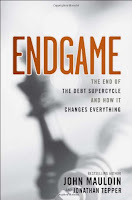
A rather more pessimistic view is taken in “Endgame, the end of the debt super cycle and how it changes everything”  by John Mauldin and Jonathan Tepper.
They believe we are heading into a second economic crisis, caused this time not by the debts of the banks, but by the debts of Governments. They fear a period of deflation, which will makes debts unsustainable, followed possibly by a period of hyper inflation,  as Governments then try to get out of their debt  difficulties by printing money.
Some of the evidence they produce is quite convincing.  Countries, like Ireland, who are borrowing on international markets, may soon find increased competition for limited funds.
The United States political system is having huge difficulty facing up to its burgeoning deficits. Already “healthcare” in the United States costs an average of 8100 dollars for every American, including the healthy ones who never get sick. Yet politicians on both sides of the divide can agree neither to raise taxes, to cut entitlements, nor take on vested medical interests.
 Japan has a Government debt of 200% of its GDP, and is able to sustain this, because it is borrowing at only 1% interest from its own people. But when more Japanese retire, and then start drawing down their savings,  Japan may no longer be able to borrow all it needs at home and will be forced to borrow on world  markets, where the  rates of interest will be much higher. That could make its debts unsustainable.
There are also property bubbles developing in China, and in Australia, where house prices are too high.
Finally there is such a thing as Austerity Fatigue.  Electorates can agree to cut back for a while, if they see a clear goal in view. But if the process is dragged on for too long, with no goal except meeting interest payments, electorates lose patience, and may make irrational decisions, as the German electorate did in 1933.
That said, we are all much more prosperous than we were in the 1930s. We are also better educated, although the German electorate of 1933 was one of the best educated of its time.
I think people need a goal that appeals to their self interest and their altruism, at the same time.  Giving a positive meaning to austerity, appealing to peoples imagination, and constantly experimenting with new low cost employment intensive  ways of  solving long standing social problems  like   energy inefficiency, the  isolation of the elderly, and  lack of locally produced food, could help  us make sense of austerity and  get us through with our sense of self worth intact.
One thing alone  is clear, the future is unpredictable, and looking for complete certainty is a waste of time! 

Tuesday, 12 April 2011

EGYPT, LIBYA, TUNISIA, PALESTINE, ISRAEL, YEMEN, AFGHANISTAN......A NEW REALITY


I attended a conference in Washington this week where some of the major  security problems of the worlds were discussed.  A few things stuck in my mind which may be of interest to visitors to this website

 A NEW ARAB WORLD
 The most important thing to happen this decade is the wind of change in the Arab world.
 The Arab world has a huge youth population, educated but  with poor economic prospects. Authoritarian methods could not control them when they had independent access to communication through the social media and Al Jazeera.
The peaceful character of the demonstrators was remarkable. Even in Yemen, where guns abound, they   have been peaceful.
Egypt will soon have free elections, as will Tunisia. This means that everybody, including Europe, the US and Israel, will have to pay attention to Arab public opinion in those two countries. It will no longer be possible to do deals with leaders over the heads of the public.

 BUT NOT EVERYWHERE
In other countries the development will not be so benign.  There will be no peaceful transition to democracy in Syria or Bahrein. Libya seems headed for a stalemate.  In the past, Al Qaeda recruited many suicide bombers from the Benghazi area, and one cannot be sure how well “liberated” Libya  will develop. The Western intervention does not have a clear end point. I wonder did people really  believe that Khaddafi would  go quietly, like Mubarak and Ben Ali, once the  West intervened.
There was a general view that the democratic revolutions have restored Arab pride.   But the economic problems the new governments will face will be severe, especially in Egypt, where the decline in tourism and the increase in food and fuel prices will hit the poor hard.  Freedom on its own does not put bread on the table.
 Iran will lose some ground because it will have fewer grievances to exploit. Turkey, as a democracy with Islam inspired Government, may become a role model, and see its influence increase.

THE PALESTINIAN PROBLEM IS STILL THERE
The Palestine question was not a central issue in the demonstrations, but a democratic Egypt may make tougher demands on Israel, in regard to Israeli settlements on Palestinian land, than the military regime was prepared to  do. President Obama started to do something to create a resolution of the Israel/ Palestine conflict at the beginning of his Administration, but now has given up, having failed to get Israel to stop building settlements that preempt the possibility of a viable Palestinian state.
Meanwhile, it looks as if Saudi Arabia, by supporting the regime in Bahrein, is opposing democratic change. Saudi oil is critical to western prosperity, now that supplies from Libya are interrupted.

AFGHANISTAN................A BELGIAN PRECEDENT?
There was pessimism about the achievability of the goal of NATO handing over security to the Afghan Government by 2014.  While progress is being made, the problem will not be resolved by 2014.
The cost of present security comes to 8 times Afghanistan’s GDP!  100000 NATO troops are in Afghanistan, but only 100 Al Qaeda operatives, and none of the Al Qaeda leadership. The leadership, and most of the operatives, are now in Pakistan.  The Pakistani army has an ambiguous relationship with some of the terrorist groups.
If NATO troops are not to remain in Afghanistan indefinitely, a new approach must be found.   One  solution suggested was  a treaty between all its neighbours guaranteeing Afghanistan’s military neutrality, was suggested.  This is worthwhile and original thought. It was the approach that led to the creation of the state of Belgium in 1830. Previous to 1830, the territory that is now Belgium had been fought over for hundreds of years.
 For this approach to work in Afghanistan, there would have to be an agreement between Pakistan, India, Iran and China, with the support of the US and Russia. It might be something that all Afghanistan neighbours might accept. An unstable failed state in Afghanistan is bad for all the  neighbours.
 But talking to Iran might be difficult for the United States, in light of Iran’s nuclear programme, which has the potential to change the balance of power in the region.  Israel is convinced that a nuclear Iran would constitute a mortal threat. But an endless NATO war in Afghanistan is unthinkable, and  financially unaffordable.